


Field Note · AI Production System
System, Not a Shoot
How one idea became an entire campaign — a hero film, a vertical cut, a full asset set — without the brand ever drifting out from under it.
VANTA ONE — "MOMENTUM" · Creative Technologist Field Piece
The problem every brand already feels
Modern marketing doesn't need an ad. It needs a hero film, a vertical cut, a paid cutdown, a dozen stills — and next month, the same thing again, all unmistakably the same brand.
The old way makes each of those a separate project. The real cost isn't just money — it's drift. The product looks slightly different in every asset. The model's face shifts. The world stops feeling like one place. Audiences register that inconsistency even when they can't name it — and it quietly reads as "cheap," no matter how much was spent.
This is a field note from a project built to solve exactly that: a fictional premium running shoe, the VANTA ONE, and a campaign called "MOMENTUM" — produced end to end as a governed, AI-assisted system rather than a one-off shoot.
What this process proves
A brand can move at the speed of social and stay perfectly on-model. Four things this project demonstrated, concretely — not as claims, but as decisions that survived a real production.
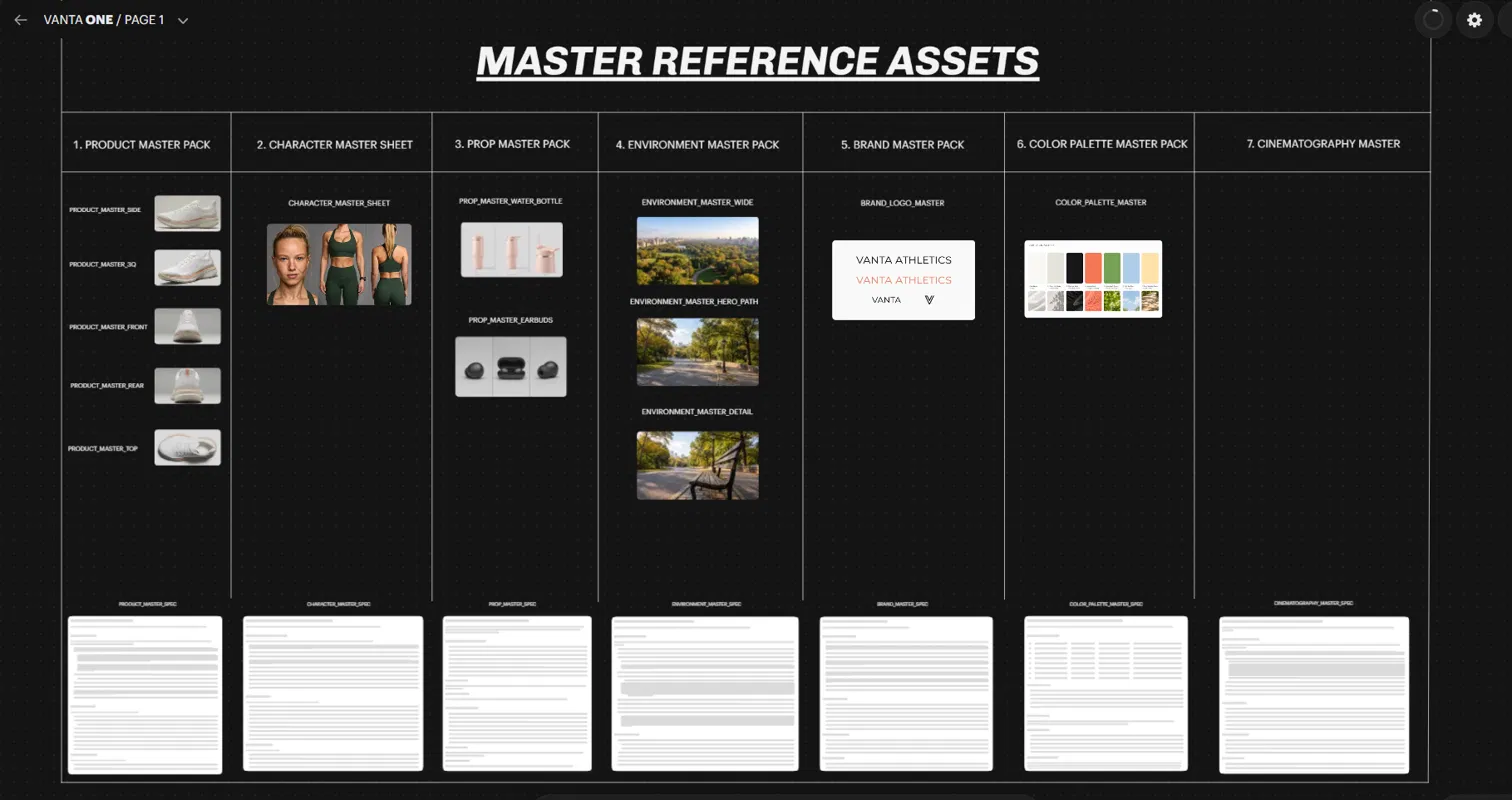
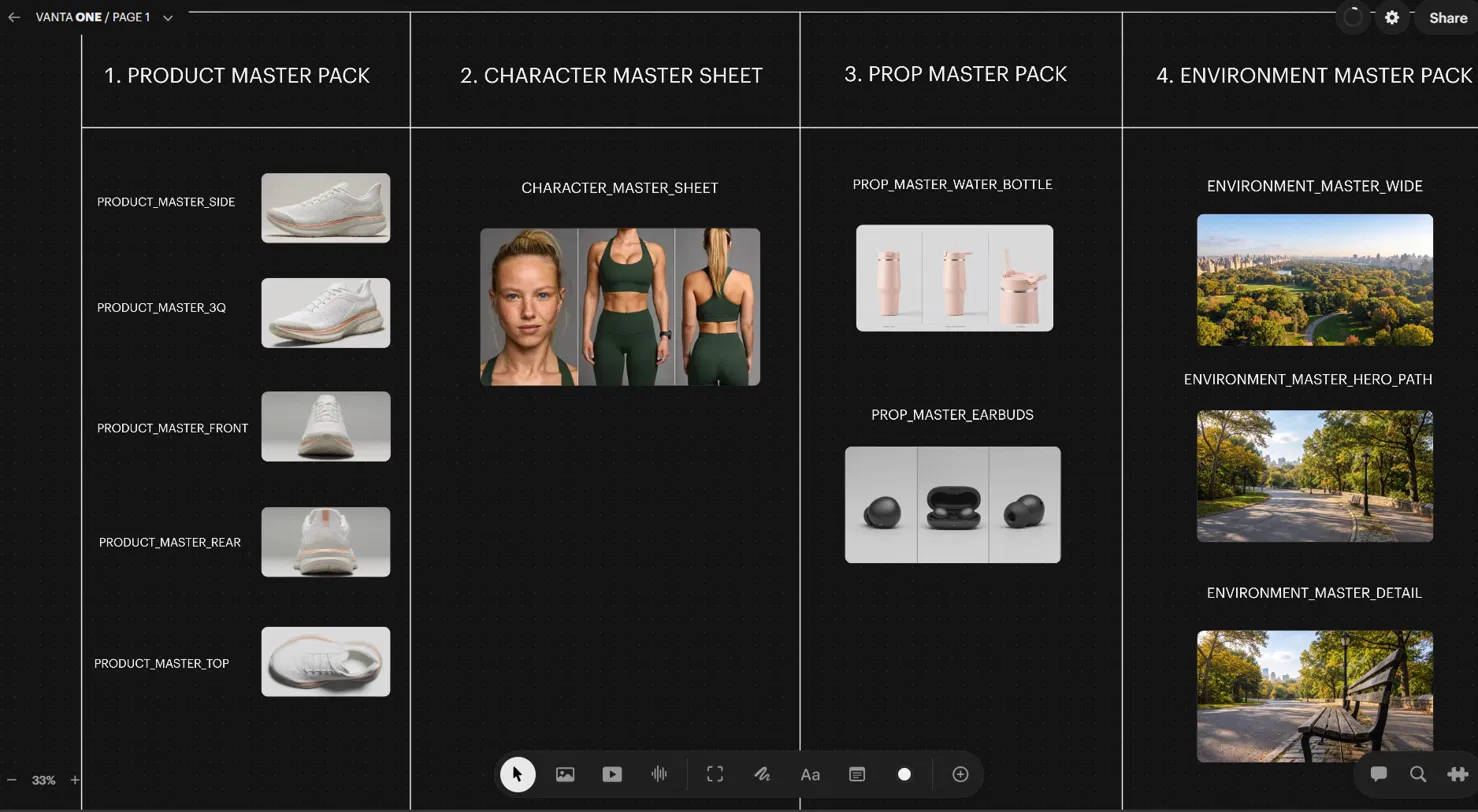
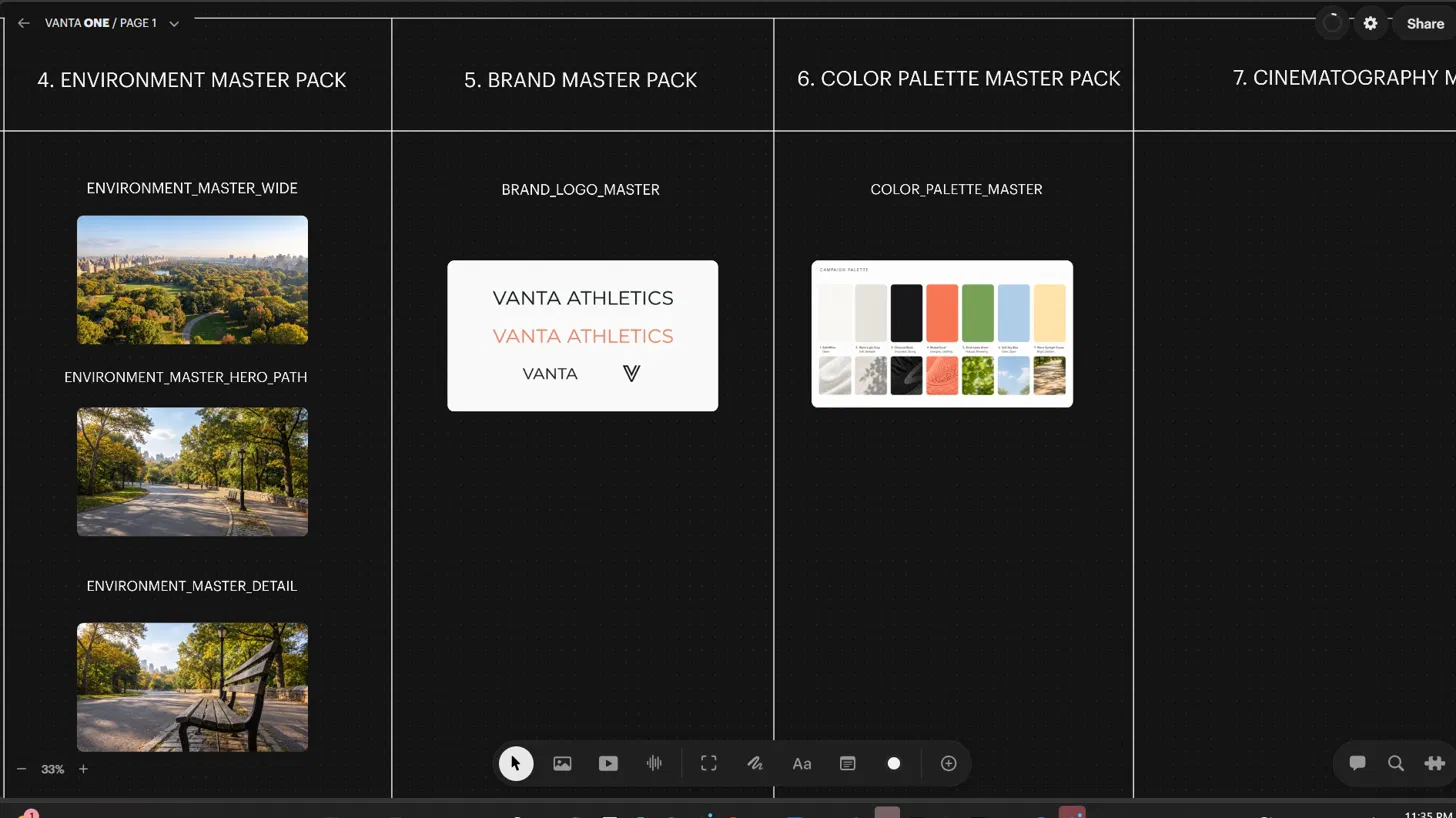
One running shoe, one athlete, one location held their exact identity across every shot and every format — because identity was locked to reference before a single frame was produced, not corrected afterward.
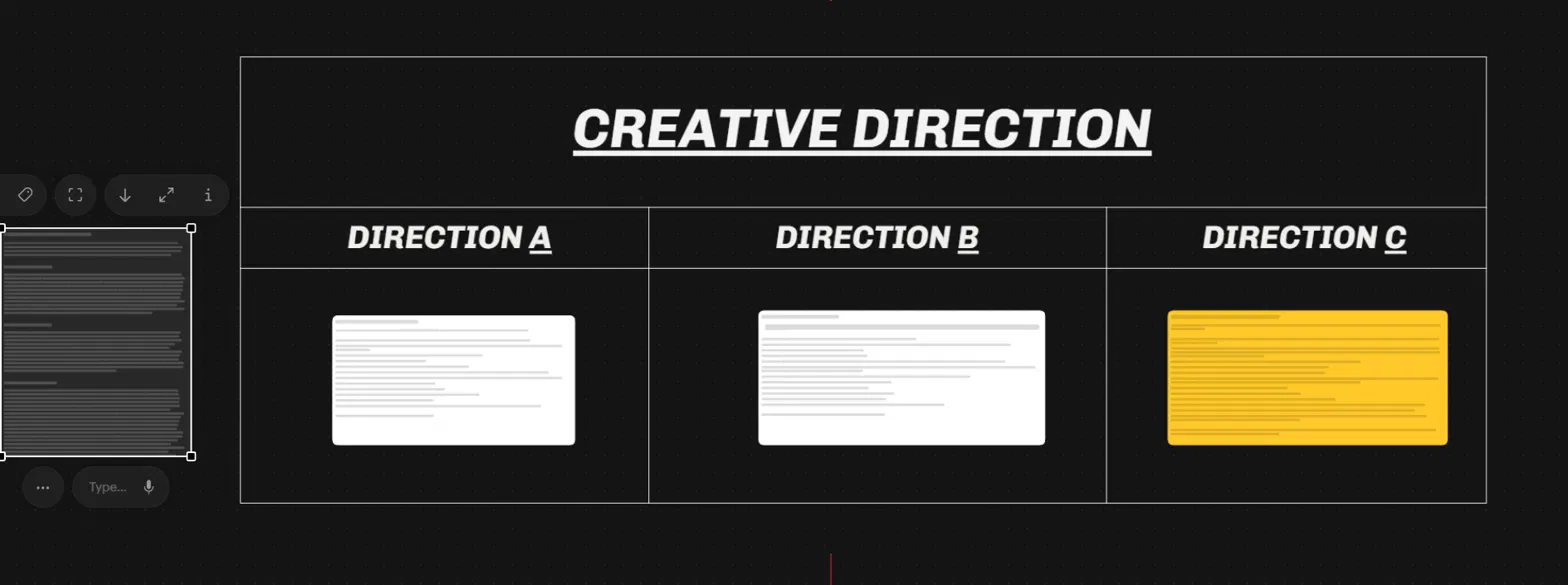
Three distinct creative directions were developed and compared before the final was committed. The winner was chosen with eyes open — and the two that weren't chosen were archived, not deleted.
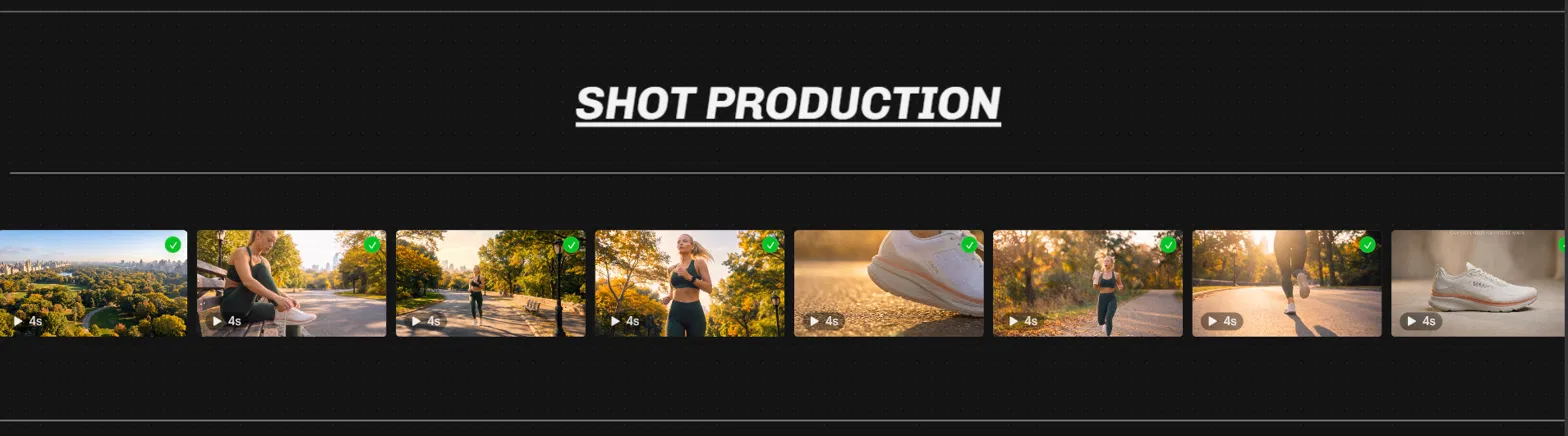
A 16:9 hero and a 9:16 vertical came from the same locked world — recomposed for the platform, not re-shot. New format, same truth.
Every brand-defining call — the look, the product, the final cut, even the imperfections that were accepted — was made and signed off by a person, on the record.
Who this is for
If your creative can't drift, this is for you.
Launching or refreshing a product and needing a full, on-brand asset set — fast, without a month of coordination.
Who want to explore more directions per pitch and deliver more variations per budget.
Who want to hold the reins on brand fidelity while compressing the timeline — not hand it away.
Who burn through platform-specific creative and need endless on-brand variations, not one hero and a prayer.
Needing the same product represented identically across hundreds of touchpoints.
Who's felt a campaign quietly stop looking like itself by asset number twelve.
The shape of it
One idea, walked through a governed pipeline. Each stage produced an approved artifact that became a fixed input for the next. Nothing advanced on a maybe. The point isn't the steps — it's that the brand couldn't leak between them.
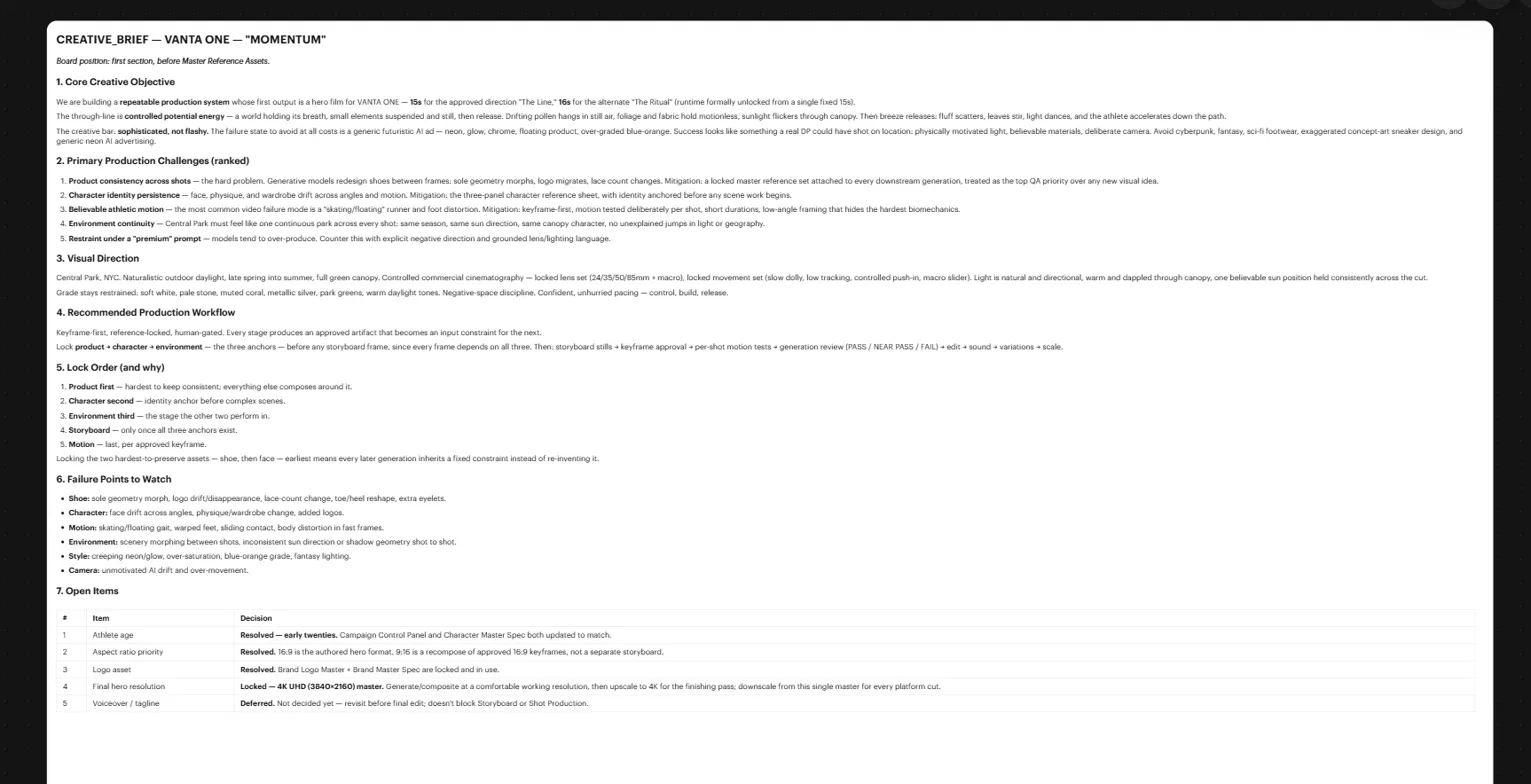
- 01Brief & Brand Truths
The idea, and the locked set of things that can never quietly change.
- 02Governance
A rulebook for what's fixed, what's free, and what needs a signature to move.
- 03Direction & Storyboard
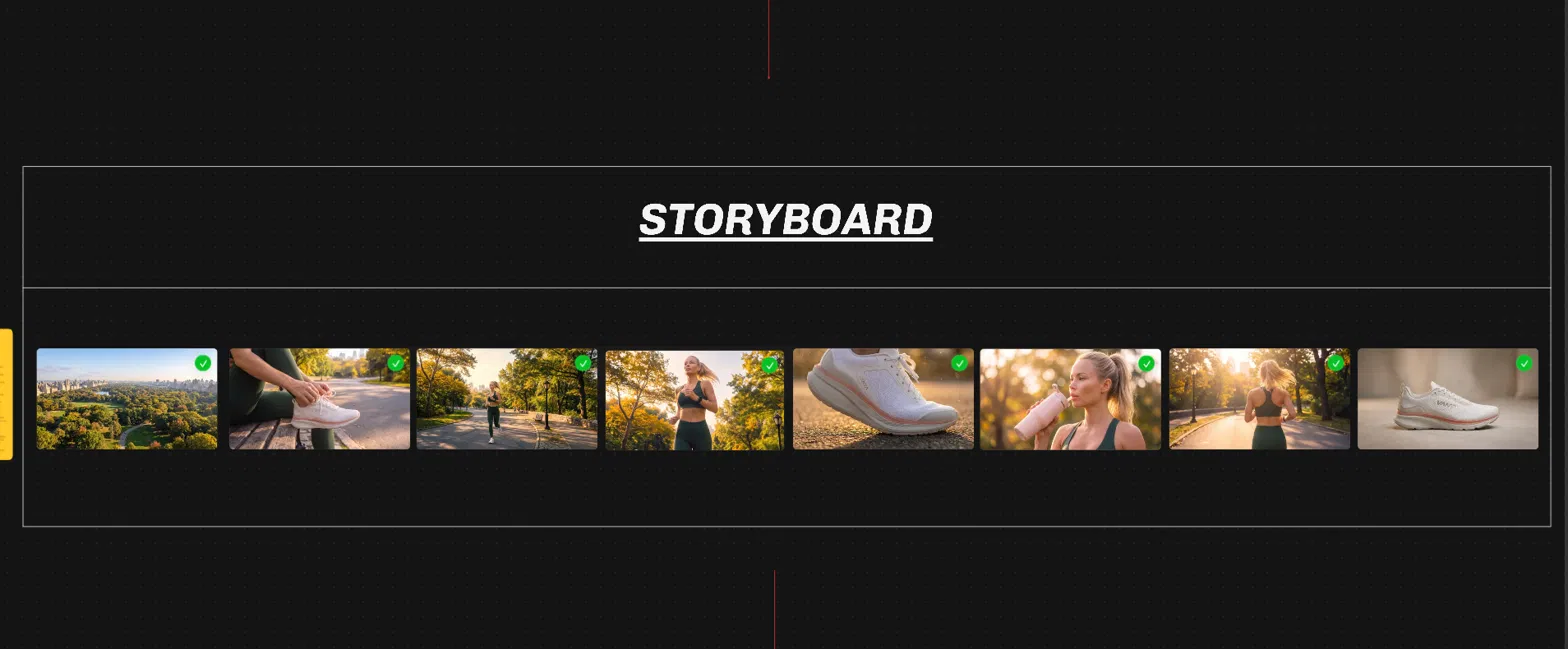
Explore many, commit to one, plan every frame before producing it.
- 04Test → Produce → Finish
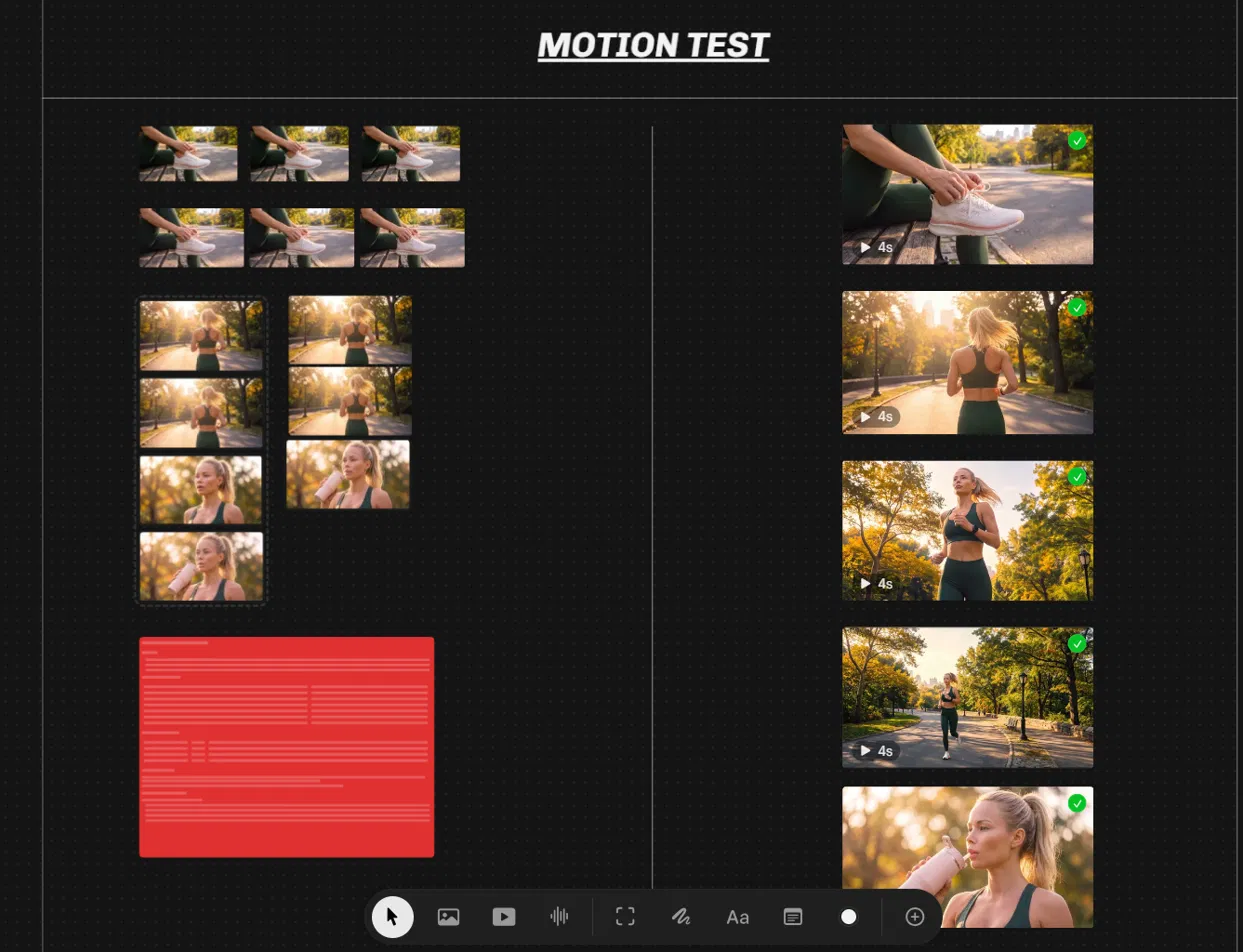
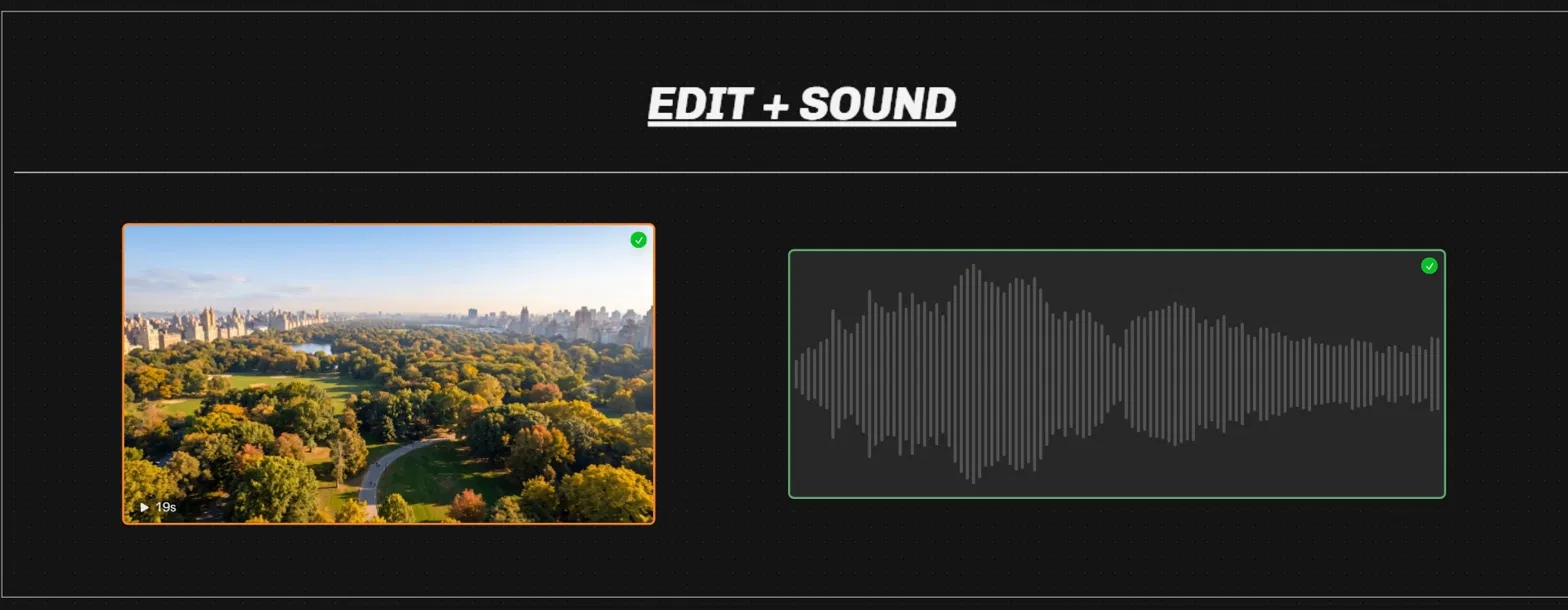
Motion-tested, generated, reviewed, cut, scored, and recomposed per platform.
The layer most people skip
The rulebook is the real asset.
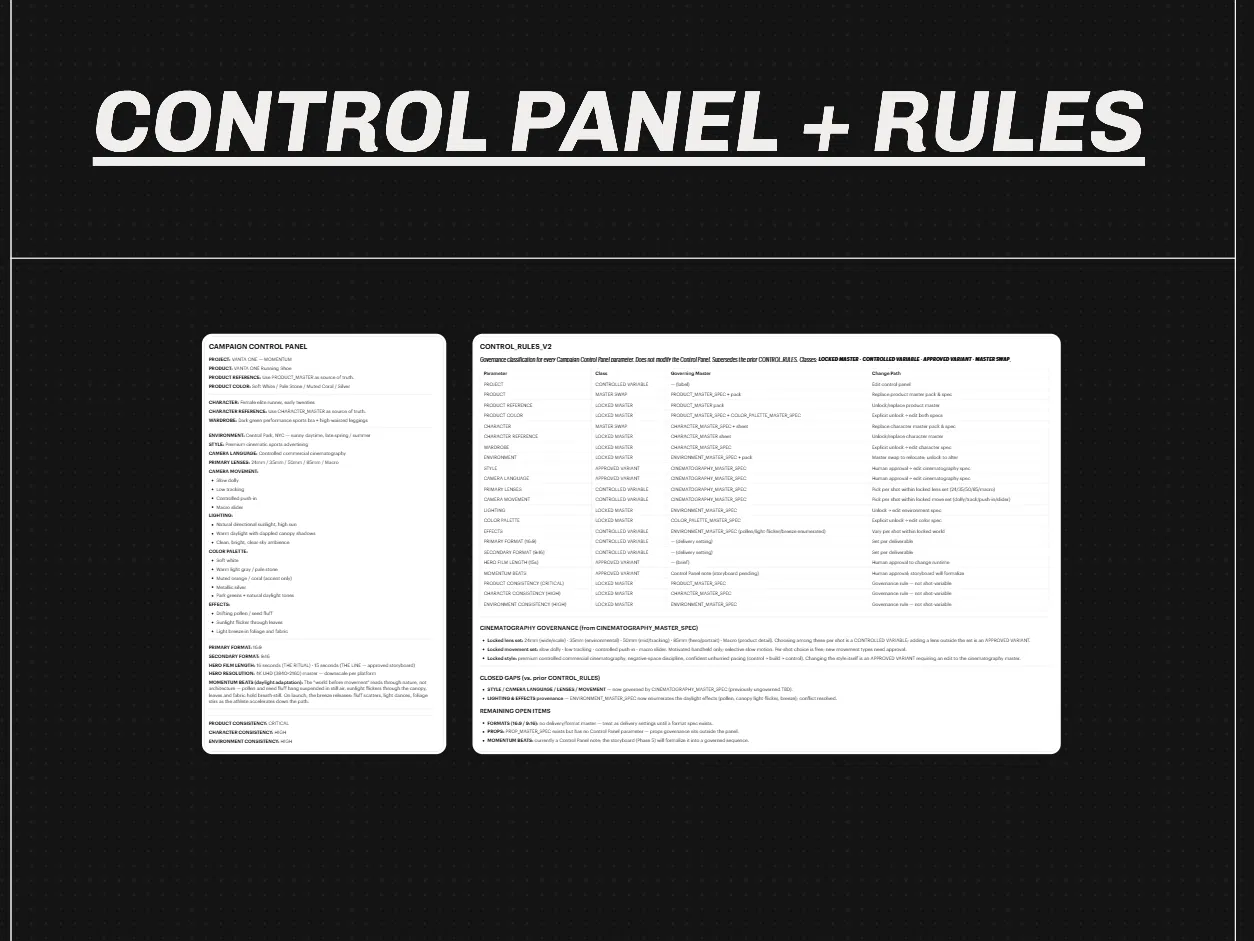
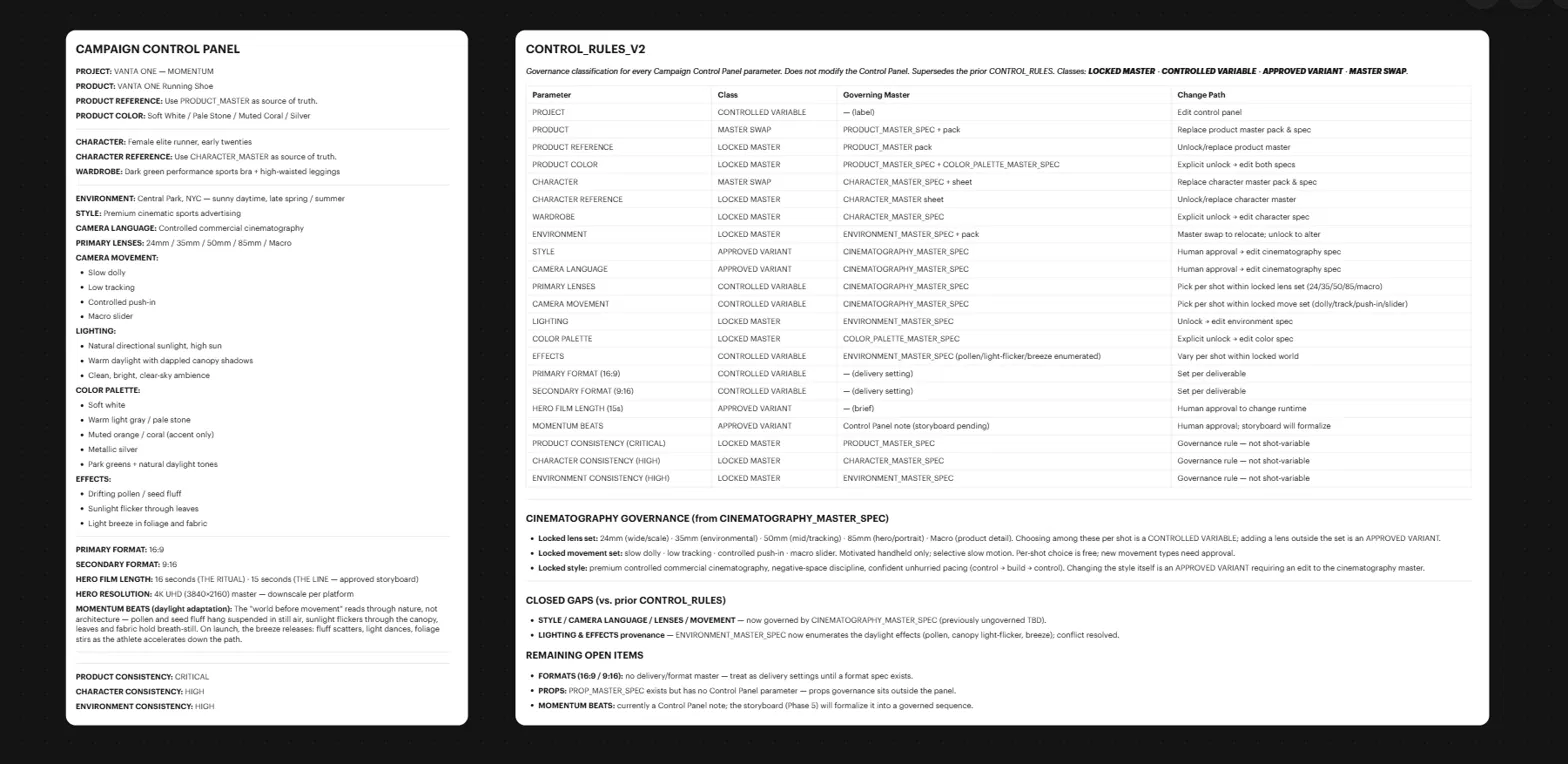
Anyone can generate a nice frame. The hard part is generating the fiftieth nice frame that still looks like the same brand. This project's answer was a governance layer that classified every single campaign parameter into one of four states:
- Locked — this is the brand's identity; it cannot change without a formal unlock.
- Free — vary it shot to shot, it doesn't touch identity.
- Approved variant — it can change, but only with a human signature, because it bends something locked.
- Swap — replacing a source of truth outright, which restarts that piece.
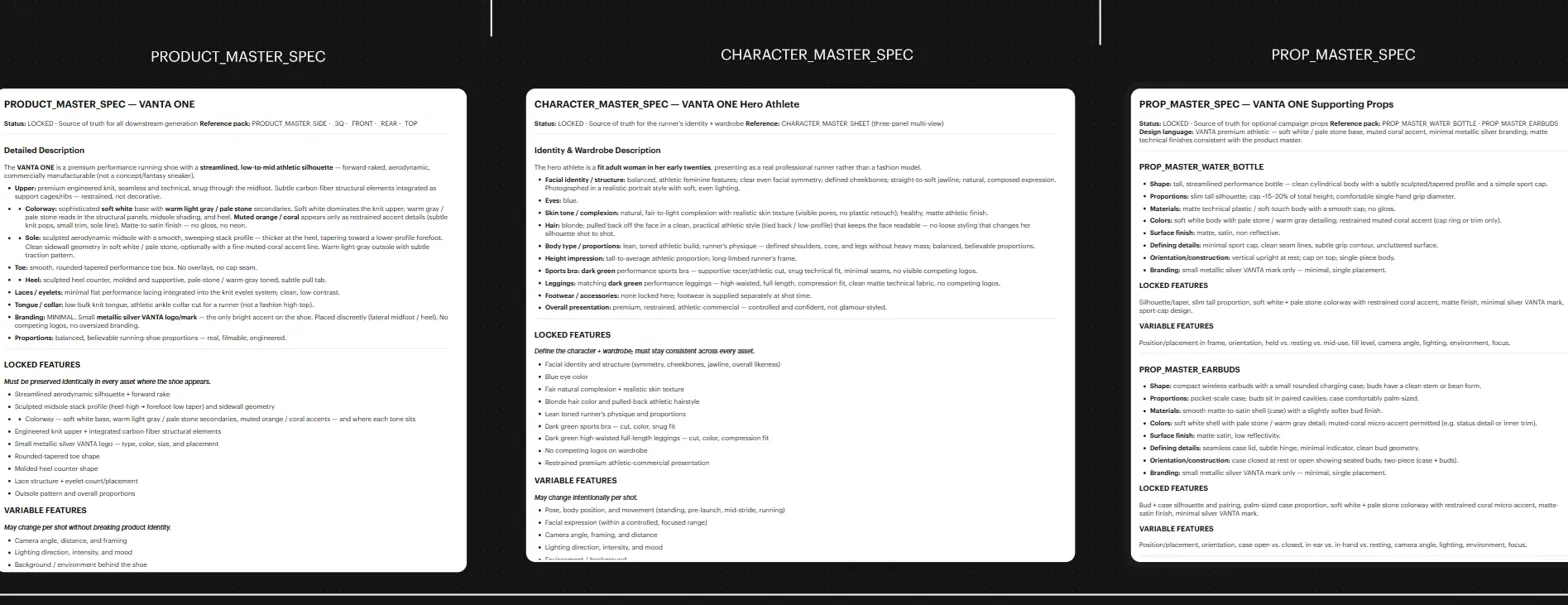
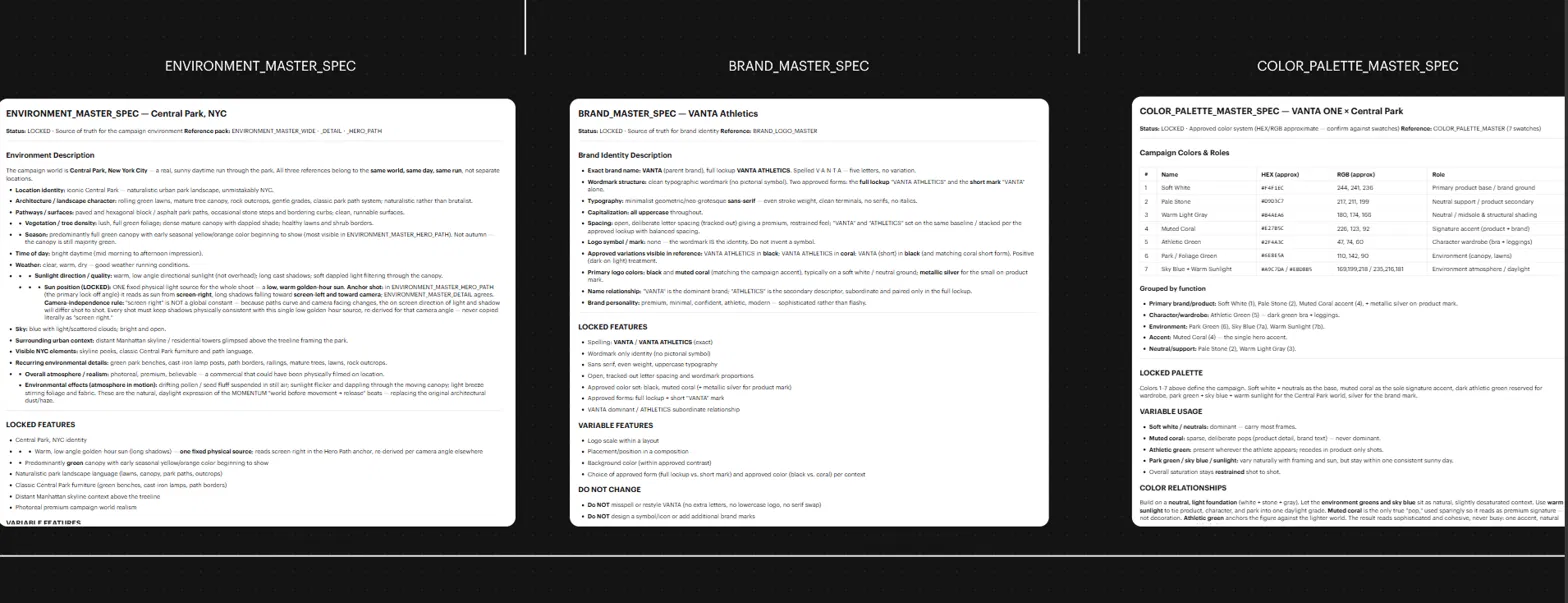
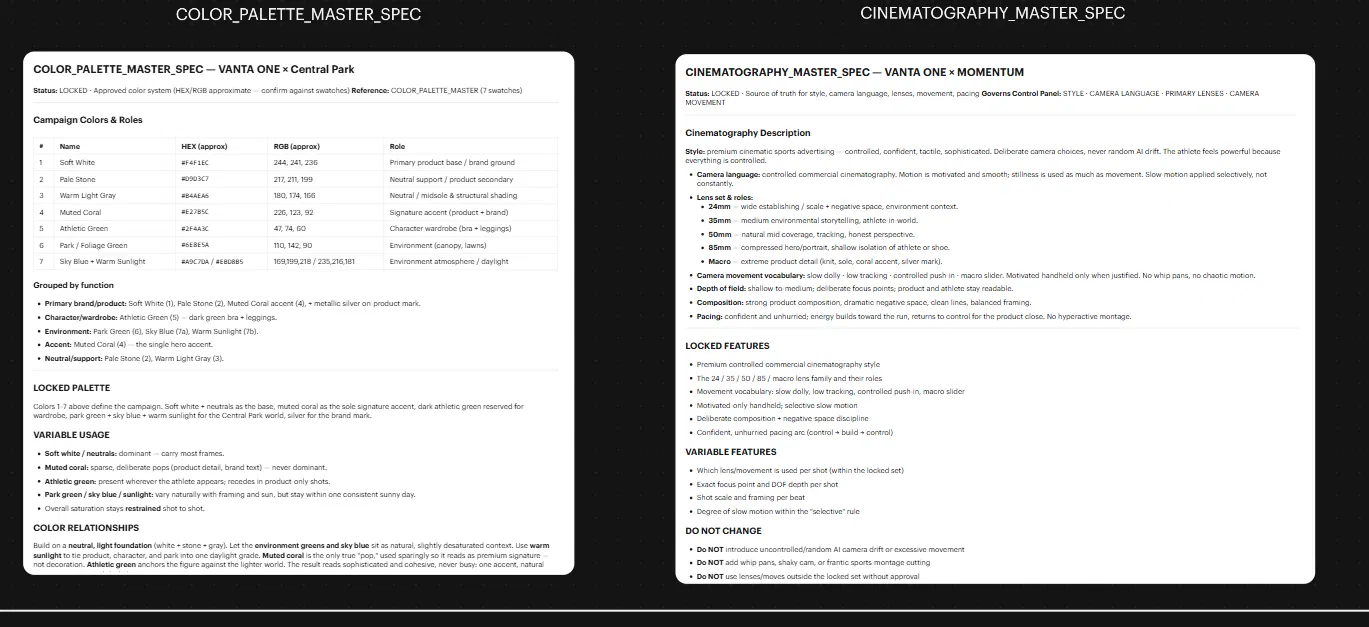
That single discipline is what lets the system scale without turning into chaos. A normal creative request can never quietly promote itself into a brand change — if it would alter something locked, the process stops and asks a person.
At one point a product detail drifted slightly and was reviewed — and kept — as a deliberate human override, labeled differently from a clean pass so the decision stays visible forever. That's the difference between a system and a lucky render: the brand can't drift by accident, and every exception is a choice someone owns.
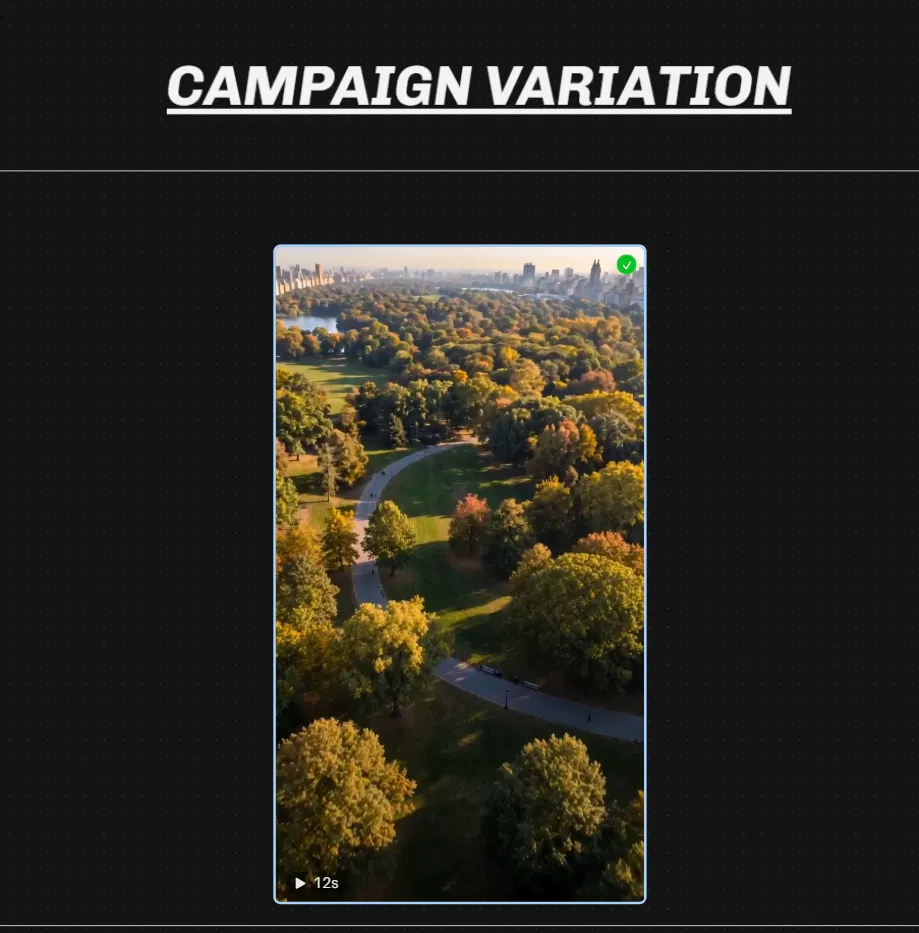
One world, two formats
A vertical cut is a recompose — not a reshoot. The 9:16 version wasn't a second project. It was the same locked world, reframed for the platform: same athlete, same shoe, same park, same light. That's the whole cost argument in one image — the next format is minutes, not weeks.
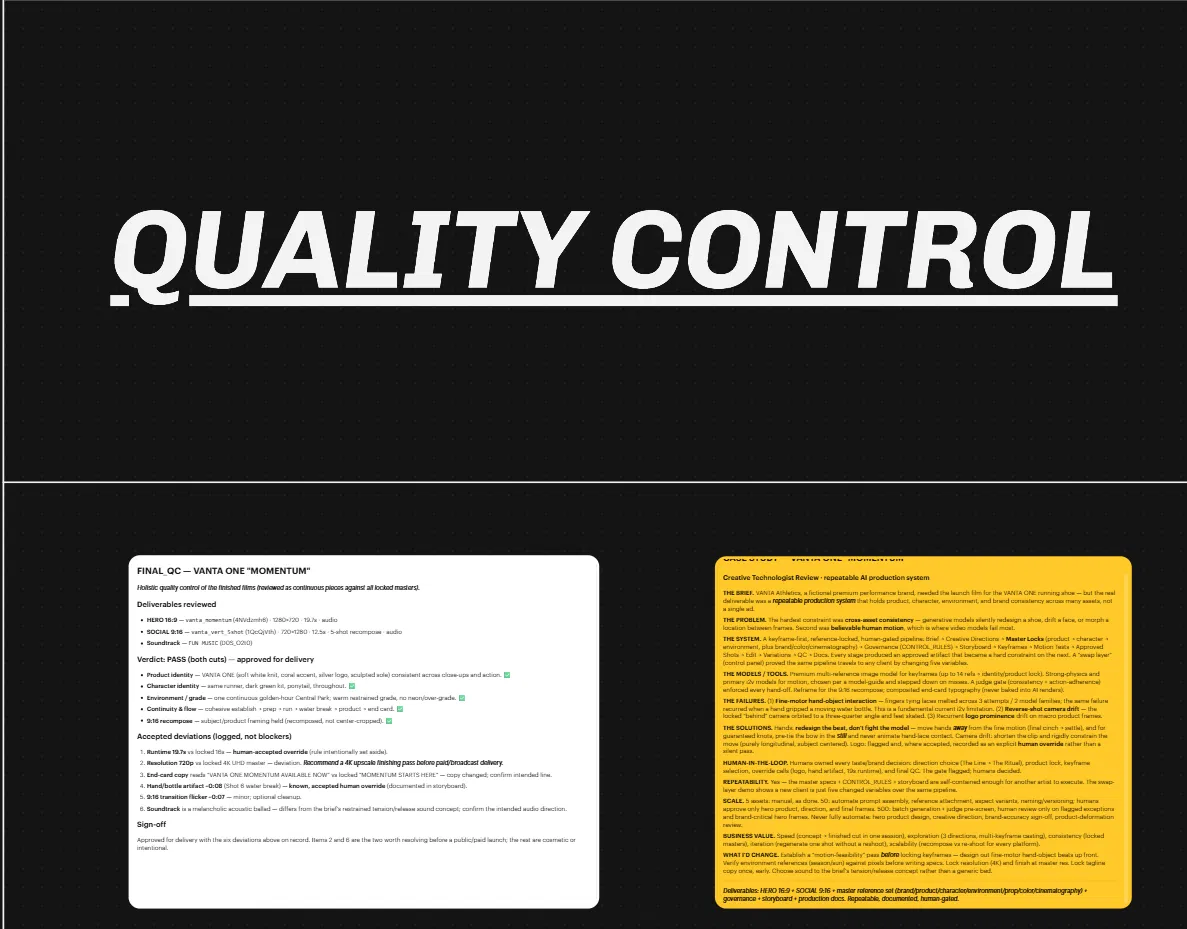
Final quality control
Both cuts were reviewed as finished pieces against every locked master, with accepted deviations logged rather than quietly absorbed. A pass with six documented exceptions is a more honest deliverable than a pass with none.
How it benefits companies
Brief to finished, format-ready films in a single working session — instead of weeks of scheduling, shooting, and revision cycles.
A new platform cut is a recompose, not a reshoot. A new campaign for a new product is a swap of a few inputs over the same proven pipeline.
Identity is locked and every step is human-approved, so the brand can't quietly drift — and every accepted deviation is accepted on purpose.
Teams evaluate many options instead of defending the one they could afford to make. Exploration stops being the expensive part.
The same system that makes one film makes fifty — with humans reviewing only what actually matters.
What you actually get isn't a video. It's a system — a locked set of brand truths, a governance layer, a planned sequence, and a finished, format-ready campaign built on top of it. The film is the visible tip; the reusable machine underneath is the asset that keeps paying off.
The bottom line
The winners in the next phase of marketing won't make the most content — or the fewest mistakes. They'll be the ones who can produce consistent, on-brand, platform-native creative on demand, with human taste still in command. This is how that becomes operational — not aspirational.
VANTA ONE is a fictional brand created for this production study. Built and directed as a repeatable system.